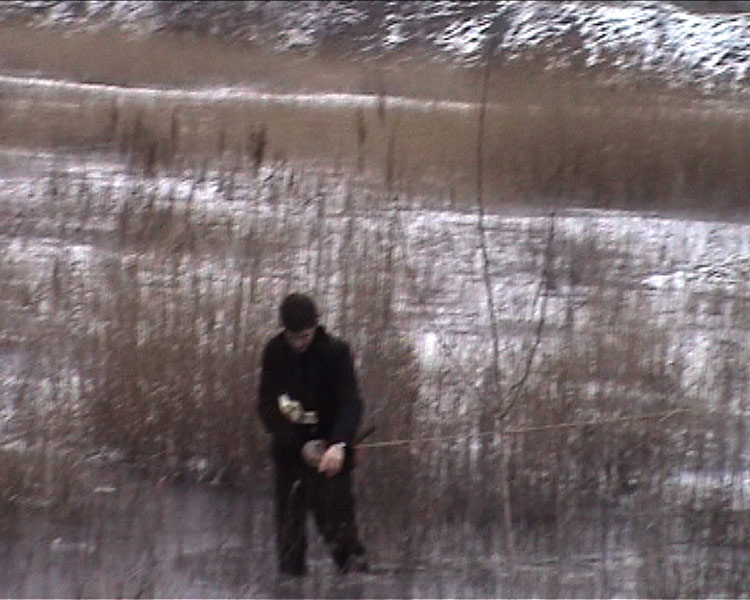
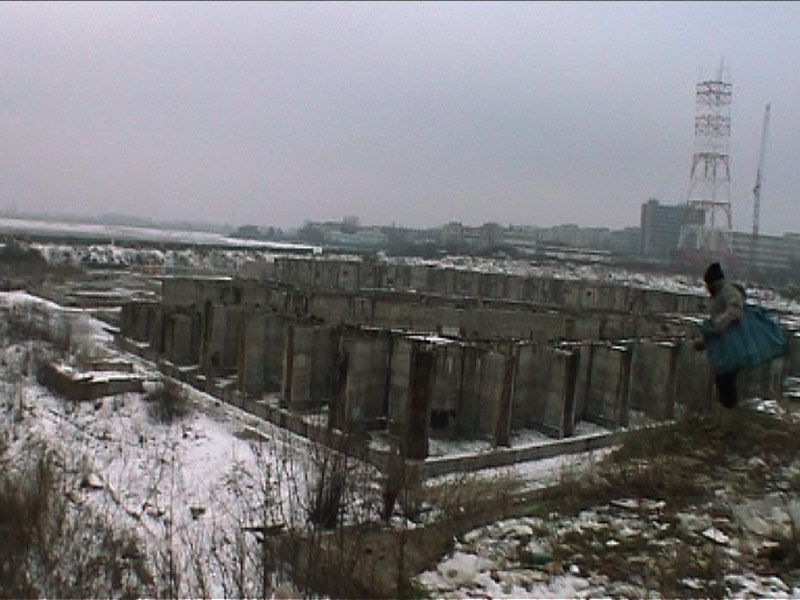
In the filmed performance
'Vacaresti', Florin Tudor traces, with string and small wooden sticks,
the outline of the church from the Vacaresti Monastery in Bucharest, demolished
by the communist regime in 1986. Retracing the shape of the lost building
functions as symbolic recuperation and gains resonance in relation to
current plans to build a commercial mall on the same site, situating the
work between an unclear 'then' and a problematic 'now', pointing at loss
and at the entropy that architecture 'constructs' while it seeks to embody
power, be it political or economic.
Another fact - the intention of the Romanian Orthodox Church to build
a gigantic Cathedral of National Redemption -, completes the background
against which this performance should be understood, endowing what may
have seemed the working-out of mourning with a marked political poignancy.
The size of the projected Cathedral is to a lesser extent the outcome
of a local understanding of monumentality, but a perverse consequence
of the gigantic abuses of communist architecture in Romania. By contrast,
the artists' performance presupposes a different understanding of the
relevance of the church in contemporary Romania, suggesting that the effort
to regain credibility should start elsewhere than in populist projects
of mass redemption and derisory magnitude.
In spite of minimal means and understated tone, 'Vacaresti' generates
a ghostly counterpart, a doppelganger designed to harass or haunt the
National Cathedral, exposing it permanently to its own disproportion and
inadequacy. If the Cathedral aspires to become a monument, then the artists'
performance is its "nonument".
Mihnea Mircan |